
February 2026 Stargazing
February is a great time to look for the Gegenschein if you are in a dark sky site.
Mercury can be hard to observe since most of the time it’s never far from the sun and usually quite low down. However, there will be an evening apparition in February 2026, because of the angle between the ecliptic and the western horizon will be rather steep. When Mercury is visible at sunset at this time, it’s quite good. Mercury will be at greatest eastern elongation on February 19, when it will be 18.1° away from the sun and that’s when it’s at its furthest position from the sun. There will be a good chance of seeing Mercury due to the steepness of the ecliptic, in the western horizon at sunset. Mercury will be quite bright. However, even in a large telescope it will remain a little tiny disc. One thing you can pick up with a modest telescope is the color which will be saffron. You won’t see any detail on Mercury, even when it’s at greatest eastern elongation because the atmosphere is going to interfere with seeing it well. Also on February 18, Mercury will be nicely paired with the one day old moon.
Venus has been through inferior conjunction and is now in the evening sky, marginally improving. At the start of February it’s magnitude minus 3.8 and sets 30 minutes after the sun but by the end of the month that will increase to 1 hour 20 minutes.
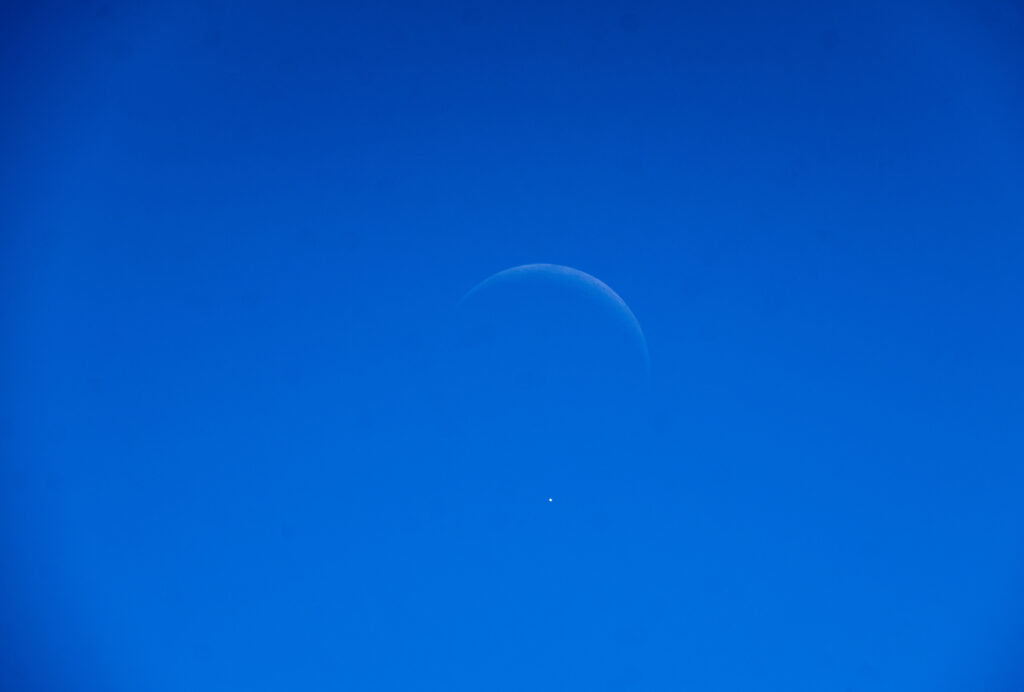
Venus will start to get out a decent distance from the sun but the angle of the ecliptic will start to drop and it will make Venus not be particularly prominent throughout the year. It’s not going to be ideal. There’s a very thin 1% lit moon between Mercury and Venus on February 18. February 28, Venus and Mercury will be in conjunction. Although Mercury will be pretty dim by that date.
Mars has been through conjunction and it’s too close to the sun to be seen, but it will start gradually pulling away and we’ll be able to see Mars later on in the year. However, in the outer solar system, Jupiter is dominating the sky, the highest position when due south under true darkness all month. It will be unmistakable in Gemini shining with quite bright about 60° in altitude when it’s due south.
There will be plenty of transits to watch on Jupiter.
Saturn’s observing window is closing this month February 1. It’s still possible to observe it against dark skies, 21° up above the southern southwestern horizon. However, it drifts west with each passing day and by the end of the month, it’s too close to the sun to be seen properly.
Uranus, though currently located 5° south of the Pleiades open cluster. So, this is a good time to try and view it if you’ve never seen it before. it’s
high up. It’s in a good position all month and you can use the Pleiades star cluster to find Uranus which will be magnitude 5.7. You will probably need binoculars or a small telescope to see a little green disc but very unmistakable.
Neptune is close to Saturn and it will have a close encounter with Saturn and a 5% lit waxing crescent moon February 19, a good time to try and locate Neptune which will be a bluish disc but then try to find its brightest moon Triton, which is surprisingly easy to pick out with a midsize telescope of maybe 8” of more.
Titan can be seen emerging from behind Saturn’s southern polar region at 1902 UT, although Saturn is getting difficult to observe now
February 10, Saturn’s tilt will now be too large for Titan to appear to cross the planet’s globe in a transit event. So, if you haven’t seen one, you’ve missed them for another 14 years but at around 2000 UT, to 12:58 you can see Titan immediately north of Saturn’s disc as a little reminder as to what could have been a Titan shadow transit.
February 11, at around 06:05 UT, the 33% lit waning crescent moon will occult the magnitude plus 2.8 star two Scorpi.
February 12, Calisto’s shadow transits Jupiter between 1900 and 2313 UT and Europa and its shadow are in transit over this time frame as well. Europa between 603 and 1857 UT and then the shadow after that between 1735 and 2030 UT.
February 18, a thin 1% waxing crescent moon sits midway between magnitude minus 3.8 Venus and magnitude minus 0.5 Mercury in the evening sky. Ganymede will be transiting Jupiter between 2220 until 0144 on the 19th. And there’s another chance to spot Titan, this time immediately south of Saturn’s southern pole at 1838 on February 18.
February 20, Calisto is occulted by Jupiter’s disc at 1729 UT, an event occurring while the sun is still up.
February 21, Calisto is eclipsed by Jupiter’s shadow at 0212 UT.
February 22, Ganymede can be seen coming out of the eclipse starting at 1909 UT.
February 24, a 44% lit waxing crescent moon approaches setting, a binocular view will show it heading ever closer towards the Pleiades open cluster.
On February 25, the lunar shadow effect known as Plato’s hook can be seen on the moon from around late afternoon from around 1730 UT. It will peak on the eastern rim which casts its shadow across Plato’s floor. Plato’s hook is the beautiful jagged shadows crossing Plato’s floor on the moon.
February 26, Ganymede transits Jupiter’s disc from 0152 UT, finishing as Jupiter
sets at about 0515 UT. The popular Luna jeweled handle cla obscure
effect is visible on the rune from around 2230 UT in the evening.
February 27 at around 2140 UT there will be another occultation occurring when Kappa Geminorum will be occulted by the moon.
The constellation Orion is going to disappear rapidly as we head into March. The most famous object in Orion is M42, the Great Orion Nebula, quite impressive. Have a look at the belt of Orion with binoculars as it is chock full of things to look at.
Globular cluster M79 in the constellation Lepus, the Hare just below Orion. M79 is one of the lowest globular clusters in the sky in the northern hemisphere. It’s about magnitude 5.8. Look for that and also look for the Planetary Nebula IC 418 near the hare’s ears.
February is a great time to observe the beautiful beehive cluster M44, in Cancer the crab. It’s a great binocular object.
Also, there is M67, by the star Alpha Canri. It’s about 1.75 degrees or so to the west of Alpha Cancri, but it’s a beautiful cluster. Often overlooked because the beehive cluster is so beautiful. M 67 is much older than M44.