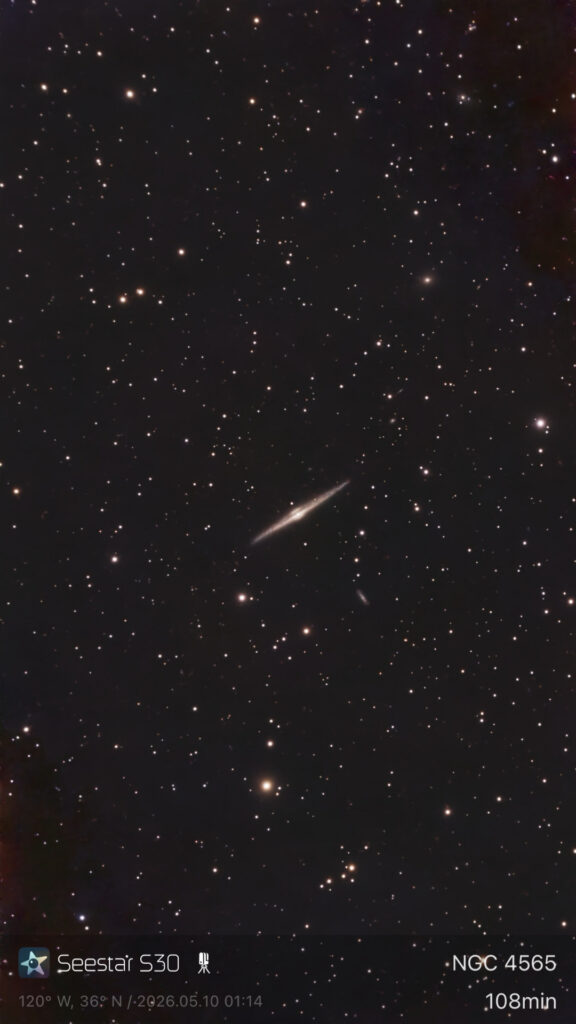
Few galaxies in the night sky are as striking through a telescope as NGC 4565. Commonly known as the Needle Galaxy, this magnificent edge-on spiral appears as a long, razor-thin streak of light suspended in space. Under dark skies, it becomes one of those objects that makes you stop observing for a moment just to appreciate what you are actually seeing — an entire galaxy viewed almost perfectly from the side.
Discovered by William Herschel in 1785, NGC 4565 lies roughly 30 to 50 million light-years away in the constellation Coma Berenices. It spans well over 100,000 light-years, making it similar in size to our own Milky Way Galaxy. In fact, astronomers often suggest that if we could travel outside the Milky Way and view it edge-on, it might resemble something very much like NGC 4565.
Finding NGC 4565
The Needle Galaxy is located not far from the bright star Beta Comae Berenices. One of the easiest ways to locate it is to begin with the Coma Star Cluster (Melotte 111), a large naked-eye cluster visible under dark skies. From there, sweep eastward with binoculars or a finder scope.
Although its integrated magnitude is around 9.5, NGC 4565 can be deceptively difficult from light-polluted locations because its light is spread across a long, narrow area. Under suburban skies it may appear faint and ghostly, while under truly dark skies it becomes spectacular.
A good finder chart or a computerized mount makes locating it much easier, especially for observers dealing with moderate skyglow.
What You’ll See Through the Telescope
In a small telescope around 4 to 6 inches in aperture, the Needle Galaxy appears as a thin elongated glow with a brighter central bulge. Even at low power, its extreme edge-on orientation is immediately obvious.
With an 8-inch or larger telescope under dark skies, the galaxy begins to show its famous dust lane — a narrow dark band slicing lengthwise through the galaxy’s bright disk. This is the feature that elevates NGC 4565 from merely interesting to unforgettable.
Larger Dobsonians reveal even more structure. The core becomes intensely concentrated while the outer arms stretch far beyond the brighter central region. The dust lane can appear surprisingly sharp on nights of excellent transparency and steady seeing.
One of the most fascinating aspects of observing NGC 4565 is how photographic it can appear visually. Many galaxies remain soft and featureless through amateur telescopes, but the Needle Galaxy often displays obvious shape and structure even to intermediate observers.
Best Conditions for Observing
Like most galaxies, NGC 4565 benefits enormously from dark skies. Transparency matters more than magnification. A moonless night away from city lights will reveal far more detail than simply increasing aperture under poor conditions.
Lower magnifications often frame the galaxy best because of its considerable length. Once centered, moderate power can help bring out the dust lane and nucleus.
Spring evenings are ideal for observing Coma Berenices, placing NGC 4565 high in the sky where atmospheric interference is minimized.
An Edge-On View of Another Milky Way
There is something especially compelling about edge-on galaxies. Spiral structure becomes hidden, but the true thinness of the galactic disk suddenly becomes obvious. NGC 4565 offers a perspective we can never have of our own galaxy from within it.
When you observe the Needle Galaxy, you are looking at billions of stars compressed into a luminous sliver of light crossing intergalactic space for tens of millions of years before reaching your telescope.
It is one of the finest galaxy targets in the northern sky and a must-see object for every deep-sky observer.