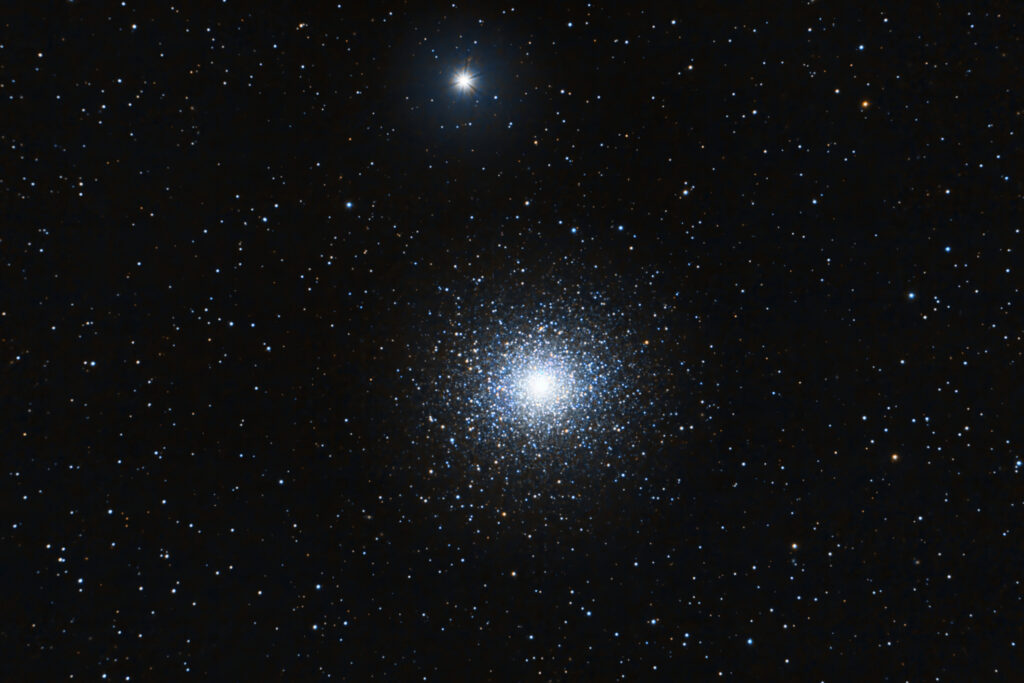
If you’ve never observed M5 before, you are in for a real treat. This object is bright and spectacular in any telescope, and even visible in binoculars and even visible to the naked eye from a truly dark sky site.
Many observers consider M 5 to be one of the very best globular clusters in the entire sky — sometimes even rivaling the famous Hercules Cluster M13.
So tonight let’s take a closer look at this ancient swarm of stars and see what it looks like through binoculars and telescopes of different sizes.
M5 or Messier 5 is also known as NGC 5904, is a globular cluster located about 24,000 light-years away in the constellation Serpens. It’s best seen in spring and summer in the northern hemisphere.
A globular cluster is a massive spherical collection of ancient stars bound together by gravity. These objects orbit the halo of our galaxy and are among the oldest known structures in the Milky Way. Astronomers estimate that the stars in M5 are about 12 to 13 billion years old. That means these stars formed not long after the Milky Way galaxy itself. And the light entering your telescope and hence your eyeball left this cluster before human civilization even existed. Messier 5 contains hundreds of thousands of stars packed into a relatively compact region of space, giving it that beautiful glowing appearance in the eyepiece.
It’s apparent magnitude 5.6 and apparent size 23 arc minutes— nearly the apparent size of the full Moon. It was discovered by Gottfried Kirch and his wife Maria Margarethe in 1702 and later catalogued by Charles Messier in 1764, mistakenly identifying it as a nebula that he said “didn’t contain any stars” and it wasn’t until 1791 that William Herschel resolved it into individual stars with his giant 40 foot telescope
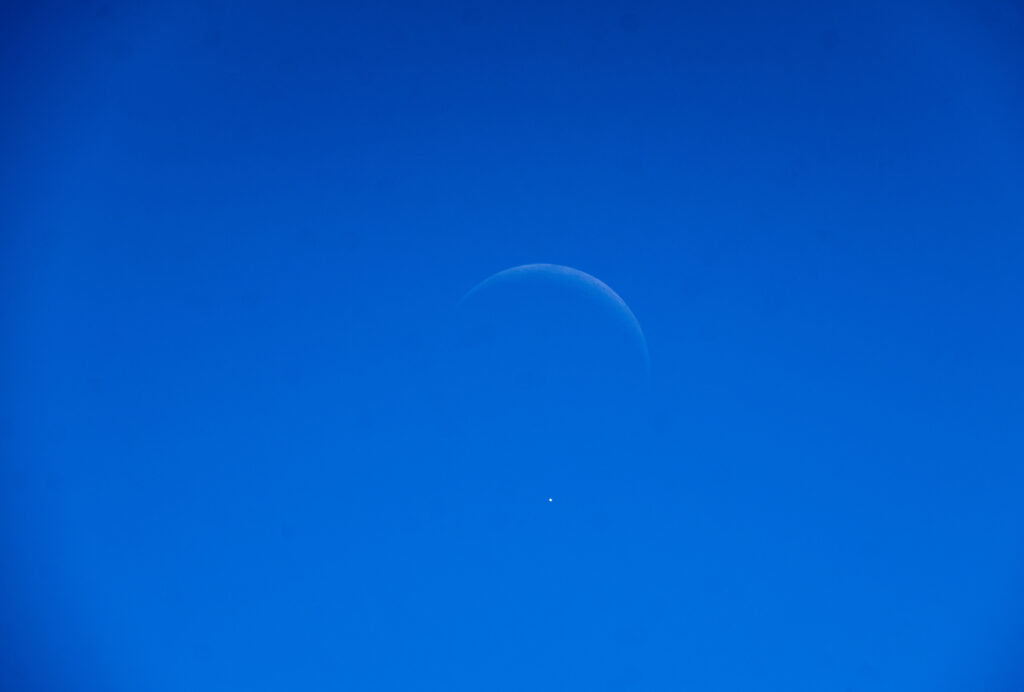
M5 is located in the constellation Serpens Caput, South of Corona Borealis and near the border with Virgo. To find M5, start with Arcturus, the brightest star in Boötes and one of the brightest stars in the night sky and head south east and you’re looking for the brightest star in Serpens Caput, Unukalhai, magnitude 2.6. So, you should be able to see that star. Serpens Caput is that crooked line south of Corona Borealis. Once you’ve located Unukalhai you’re going to go 7 degrees southwest to a magnitude 5 star, 5 Serpentis and M5 is just half a degree from that star.
In binoculars or your finder scope, M5 will appear like a small fuzzy glow. And in binoculars you might be able to fit Unukulhai in the same field of view with M5 depending your binocular’s field of view.
Through 10×42 or 10×50 binoculars, M5 appears as a small hazy patch of light with a brighter center. You won’t be able to see individual stars, in binoculars but you can definitely tell it’s something not a star. Under dark skies it looks almost like a tiny unresolved comet suspended among the background stars. Just seeing this globular cluster with binoculars is pretty amazing when you think about what you’re seeing.
You’re observing an ancient gravitationally bound city of stars tens of thousands of light-years away using just a pair of binoculars. Pretty neat.
In a small telescope, 4-inches or so— M5 really starts to come alive.
At low power, the cluster appears as a bright round glow with a very concentrated core.
But as you increase the magnification, something magical starts happening.
The outer edges begin to break apart into countless tiny pinpoint stars. This is called resolving individual stars. You’re no longer just looking at a fuzzy patch. You’re seeing individual suns packed together by the thousands. Observing M5 through an 8-inch or larger telescope, the view becomes absolutely spectacular. The cluster explodes into stars. The outer regions become richly resolved with chains, arcs, and streams of tiny stellar points radiating outward from the blazing core.
One thing I really love about M5 is how dense and textured it appears. There’s this incredible three-dimensional effect — almost like diamond dust scattered across black velvet.
And unlike some globular clusters that remain stubbornly unresolved in the center, M5 often shows remarkable detail all the way to the core. When the seeing is good and you can magnify enough, it becomes almost overwhelming how many stars are visible.
It’s one of those objects where you can spend a long time at the eyepiece just exploring all the details. And this object begs to be sketched. Sketching it is a real challenge though.
Best Magnification for M5 is moderate to high magnification. A common mistake beginners make is observing globular clusters at only at very low power. Try gradually increasing magnification until the cluster begins resolving cleanly while still remaining bright. Usually you’ll want to magnify somewhere around 100x to 200x but if you have a larger aperture telescope go well past that magnification. Higher magnification darkens the background sky and helps separate the stars from one another. And because M5 is relatively bright and compact, it handles magnification very well. Usually when you hear about globular clusters, people will often say M13 is the best globular cluster in the northern skies. But many observers prefer M5 and the reason is the richness of the cluster but also the beautifully concentrated core. It resolves more cleanly and appears more condensed than M13. Both globular clusters are incredible. Lately I have been finding observing M5 to be more exhilarating and if you haven’t observed M5 you need to.
Here are some tips to get the best possible view of M5:
First, go to the darkest place you can. Although Globular clusters hold up well in light pollution, darker skies still reveal far more stars and just look far more spectacular.
And of course let your eyes fully adapt to the darkness. And third, spend some time at the eyepiece. The longer you observe, the more detail you’ll see. You’ll start to see curved star chains, darker lanes, and subtle variations in the density of the cluster.