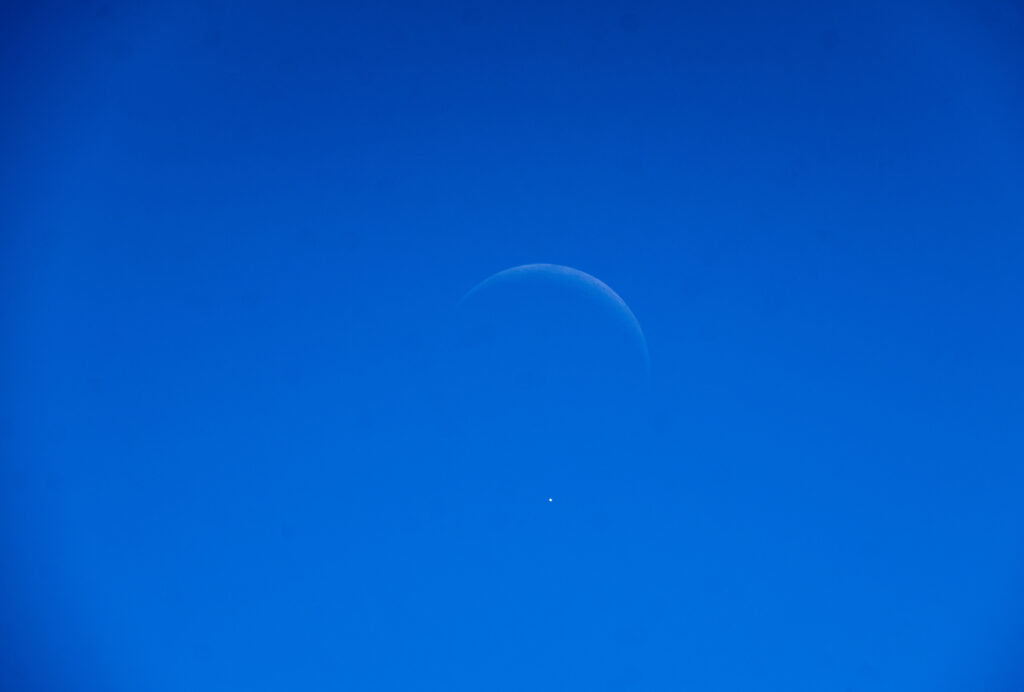
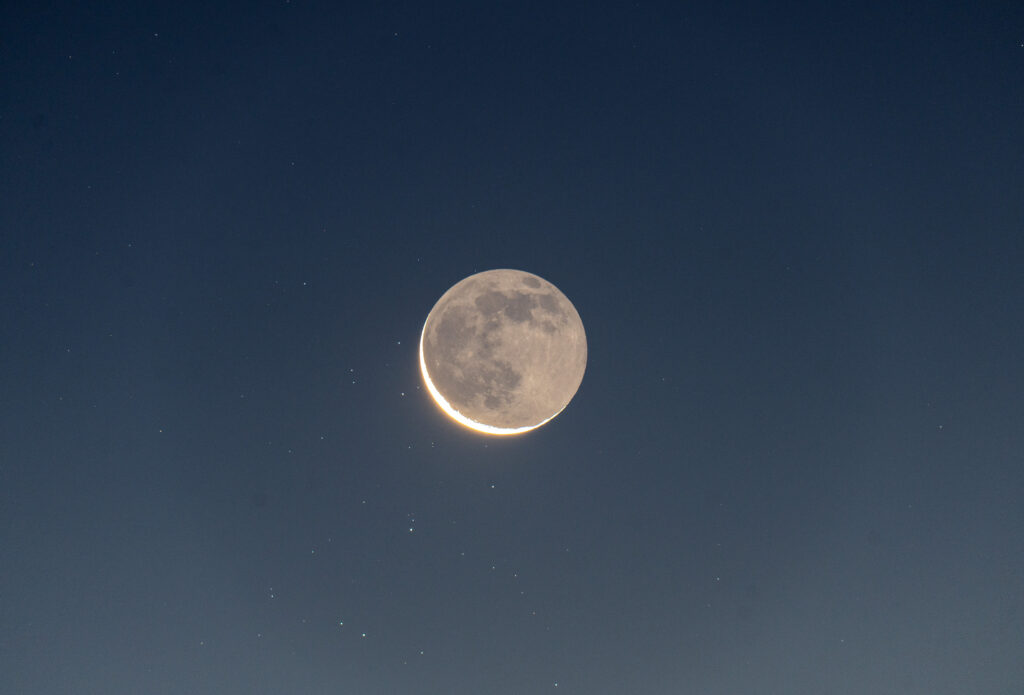
At 4:00 a.m. PDT on June 13, the world felt unusually quiet. Everyone in the campground had long gone to bed. The Milky Way was well past its beautiful arch of earlier in the evening.
The eastern sky was still wrapped in darkness, save for a few bright stars and the soft glow of a waning gibbous Moon hanging above the horizon. But this wasn’t an ordinary morning skywatching session. The Moon was passing directly in front of one of the most beautiful star clusters visible to the naked eye: the Pleiades.
Known as the Seven Sisters, the Pleiades have captivated observers for thousands of years. Under dark skies, the cluster appears as a tiny dipper-shaped grouping of blue-white stars in the constellation Taurus. Through binoculars, dozens more stars emerge, creating one of the sky’s most striking sights.
On this morning, however, the Moon had other plans.
As I watched through binoculars, the bright lunar disk slowly approached the cluster. One by one, the stars seemed to vanish as they reached the Moon’s dark edge. There was no gradual fading. Each star simply winked out, instantly hidden behind the Moon’s airless limb. The effect was startling, even when expected.
The contrast between the brilliant Moon and the delicate Pleiades made the event especially dramatic. Normally, the cluster stands out easily against a dark sky. Yet as the Moon drifted through it, the stars appeared to play a celestial game of hide-and-seek, disappearing and reappearing as the hours passed.
What makes an occultation so fascinating is the sense of motion it reveals. The stars of the Pleiades are unimaginably distant, over 400 light-years away. The Moon, by comparison, is only about 240,000 miles from Earth. As it moves along its orbit, the Moon’s motion becomes visible in real time against the seemingly fixed background of the stars.
It’s easy to think of the night sky as static. Events like this remind us that the heavens are constantly changing.
Standing beneath the predawn sky, I found myself reflecting on how many generations before us have watched the same cluster. Ancient Greek sailors, Indigenous skywatchers around the world, astronomers with early telescopes, and modern observers with digital cameras have all looked up at these stars and felt a similar sense of wonder.
For a few moments on June 13, the Moon transformed that familiar star cluster into a dynamic performance. The stars disappeared behind the lunar limb and later emerged again, continuing their journey across the sky as if nothing had happened. I have added one of the many photos I took of this memorable event for my new friend, Liz, whom I met on my camping trip to dark skies. I will add more later. Enjoy.
The entire event served as a reminder of one of astronomy’s greatest rewards: sometimes the most memorable sights don’t require rare equipment or a distant observatory. They simply require staying awake until dawn, looking up, and being present when the universe decides to put on a show.
Dark Skies Forever.