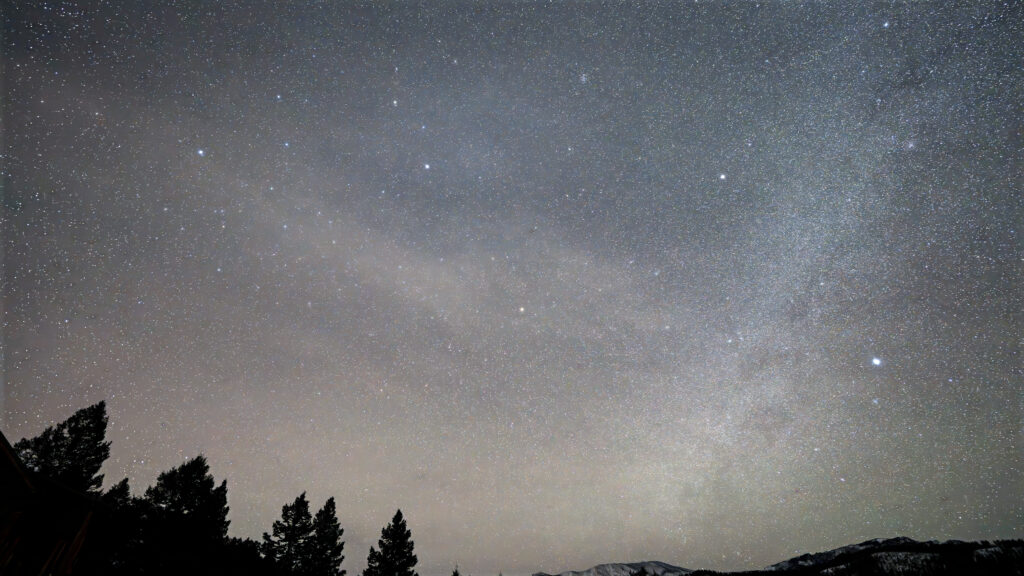
The Gegenschein is German for counterglow. And it’s generally agreed that Danish astronomer Theodor Johann Christian Ambders Brorsen was the first to publish a clear and unambiguous description of the gegenschein in 1854. He studied the zodiacal light and the zodiacal band, noticed the brighter patch near the anti‑solar point and carefully measured its position among the stars in March and April 1854. The Gegenschein is one of the most elusive naked-eye objects in the entire night sky.
It’s not a comet.
It’s not a nebula.
It’s not even technically a deep-sky object.
And if you’ve never heard of it… you’re not alone.
Most amateur astronomers spend years chasing galaxies, nebulae, globular clusters and the sort.
But very few ever try to see the faint glow that sits exactly opposite the Sun in the sky.
That’s the Gegenschein. And once you finally see it, it feels like you’ve unlocked a secret level of the night sky.
So, what is the Gegenschein? The Gegenschein is a faint, oval patch of light that appears at the antisolar point — the exact spot in the sky opposite the Sun. It’s caused by sunlight reflecting off interplanetary dust particles lying in the plane of our solar system. That dust scatters light directly back toward us, producing a subtle glow. This is related to the same phenomenon that creates the zodiacal light — but instead of stretching up from the horizon, the Gegenschein sits out in deep space right on the ecliptic. Right at opposition to the sun.
The reason most people never see the Gegenschein is obvious: it’s extremely faint and to see it you must go to a dark sky site on a night with No Moon and Excellent transparency, and you must have patience to see it.
This is not something you “stumble into.” You have to hunt for it deliberately.
Under Bortle 3 skies, where I live in Montana, it will be subtle. In fact, one article I read proclaimed that you cannot see the Gegenschein at all unless you are in a Bortle 1 or 2 and at the top of a mountain on a clear moonless night. Well, I don’t agree with that but it is hard to see; I will grant you that.
If you can find a Bortle 1 or 2 site, the Gegenschein will become much more obvious but it will remain delicate. It will appear as an oval patch of sky 10° across that is subtly brighter than the rest of the sky. It will not be a glowing blob! But more likely just a patch of the sky just barely thicker than the rest of the sky.
The best time to look for the Gegenschein is around local midnight, when the antisolar point is highest in the sky. February and March are considered the best months at mid-northern latitudes to look for the Gegenschein because the antisolar point will be higher in the sky and you won’t have to wade through so much atmosphere which could hinder your view. The best time to look for the Gegenschein from the southern hemisphere is June and July, their winter months. The Gegenschein is present all year but it shifts through the constellations along the ecliptic and you cannot see it when it coincides with the Milky Way because the Milky Way will wash it out.
To find the Gegenschein look where the Sun is during the day and then Project that position 180 degrees across the sky. At midnight, that point will be due south (if you’re in the northern hemisphere. The Gegenschein will lie along the ecliptic, the apparent path the sun, the Moon and planets across the sky from our vantage here on earth. From my latitude of 45 degrees that means somewhere near Leo or later in February the Leo Virgo border.
That’s where you want to look for the Gegenschein but don’t stare directly at that area. Instead sweep your eyes slowly and use averted vision. Compare the region of the sky to areas slightly above or below it. You’re looking for a subtle oval enhancement in comparison to the rest of the sky. Once you detect it, it becomes surprisingly obvious. It will be delicate though. It will not look like a nebula and it will not look structured. It will just look like a gentle concentration of skyglow in the shape of an oval centered on the ecliptic. When you find it, knowing that what you’re seeing is sunlight bouncing off dust between the planets will make it all the more special and give it weight to know you are seeing the plane of the solar system with your naked eyes.
Seeing the Gegenschein for the first time was very exciting to me. I was elated. How special. Our solar system is filled with fine dust, the remnants of asteroid collisions and comet debris — forming a vast, flat cloud around the Sun. And on the right night, in the right place, a very dark place under transparent skies we can see it. No telescope is required just the ever elusive and disappearing dark sky above.
If you’ve seen the Gegenschein before let me know about it in the comments. And if you haven’t seen the Gegenschein this is your naked eye challenge to do so.
Choose a moonless night, go somewhere truly dark, be sure to let your eyes dark adapt, then look for the antisolar point, and then you’re ready to look for the faintest secret the night sky has to offer. I’m so glad I sought it out and finally saw the Gegenschein! I think I’ll add it to Tsula’s top 10 or 11 astronomical objects.