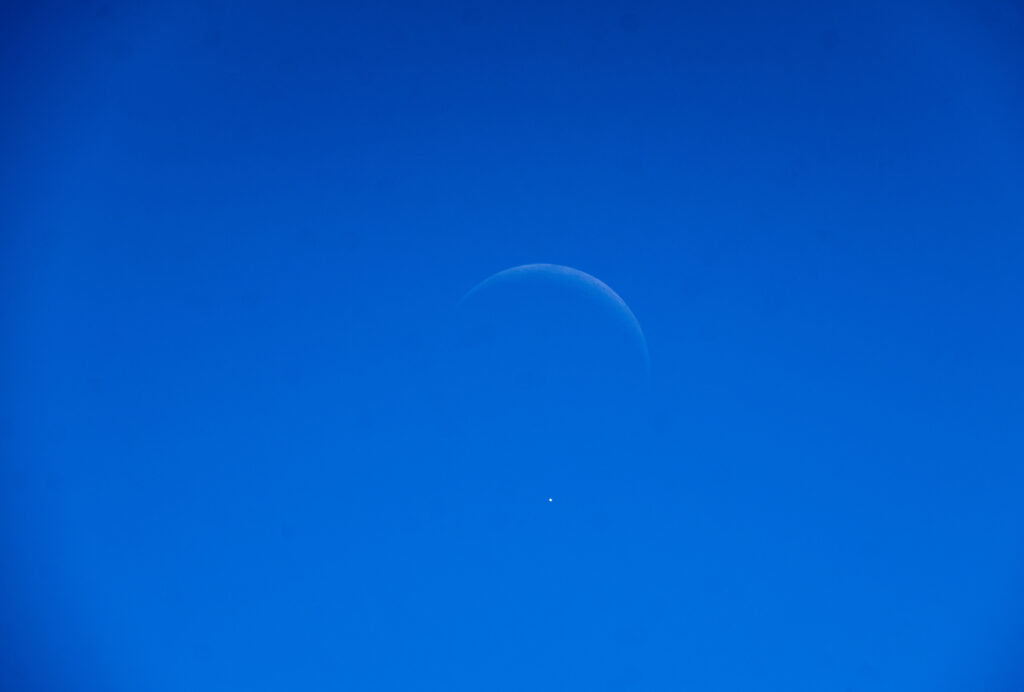
Jupiter reaches opposition on January 10, 2026, the best time to view Jupiter and any planet. Find Bright Jupiter in Gemini the Twins until dawn. Uranus is in Taurus the Bull until 4 AM and sets earlier every night, until 2 AM by the end of January. Saturn and Neptune can be found high in the sky as well. Last quarter moon is January 10, at 10:50 AM. New moon is January 17, 2026.
Sirius, Betelgeuse, and Procyon will be up until the morning. See the Summer Triangle of Vega in Lyra the Harp, Deneb in Cygnus the Swan, and Altair in Aquila the Eagle as of 6:30 AM, and rising earlier every day this month. Find Capella in Auriga, Arcturus in Boötes the Herdsman, Spica in Virgo, Vega in Lyra, and Aldebaran in Taurus until the morning. See the stars of Leo, Gemini, Cassiopeia, Hercules, Hydra, Cepheus, Draco, Libra, and the two Dippers.
NGC 2237 – The Rosette Nebula
If you want to see the Rosette Nebula with a telescope, you’ll need to visit a dark sky site, have a telescope with a minimum aperture of 150mm (6 inches), and use a UHC or OIII Filter. However, this is an excellent target because the nebula is large and beautiful from a dark sky site.
The Great Orion Nebula
Several thousand light years away is one of the most epic nebulae in the sky, Messier 42 or the Great Orion Nebula.
It is visible as a tiny misty patch just below the three stars of Orion’s belt, but a telescope will show a large greenish gray cloud with a tiny group of hot young stars, the trapezium, sparkling at its center. The Orion Nebula is sure to dazzle in whatever instrument you use to view it. It is simply splendid to view through an eyepiece.
Messier 41 – Star Cluster
Messier 41 lies just slightly south of Sirius and is visible to the naked eye under dark skies. Binoculars will show a tiny hazy patch, while a telescope at low power reveals a multitude of blue-white stars of almost equal brightness. Look for a brighter pair, one of which is orange. The cluster also images well with a smart telescope.
The Hyades Cluster
In the heart of Taurus is a very beautiful star cluster that’s not too far away, the Hyades Cluster. If you follow the three stars of Orion’s belt upwards, you’ll come to a V-shaped group of stars. This is the Hyades star cluster, and it represents the head of Taurus, the bull. The reddish star is Aldebaran, the brightest star in the cluster and it marks the red eye of the bull. The Hyades star cluster is best seen with a pair of binoculars.
The Beehive Cluster
M44 is the beautiful Beehive Cluster. It can be seen with your naked eye and is gorgeous in binoculars or a small telescope. You can find it in the faint constellation Cancer but is more easily found by starting at the bright twin stars of Gemini, Castor and Pollux and heading half-way to Regulus, the brightest star in Leo the Lion.
NGC 2264 is the designation number for both the Cone Nebula, and the Christmas Tree Cluster. It is located in the faint constellation Monoceros but you can more easily find NGC 2264, by looking for the star Cluster which is much easier to see than the nebula, by starting at the constellation Gemini the twins whose two brightest stars are Castor and Pollux. Start at Pollux and go to his foot and just below it you’ll find the cluster. If it’s dark enough where you are put in a UHC filter and you should be able to make out the nebulosity around the cluster.